
Exploring the Top 5 Aquascaping Styles Every Beginner Should Know

Aquascaping transforms a simple aquarium into a living work of art. For beginners, choosing a style can feel overwhelming. Each style offers a unique way to arrange plants, rocks, and wood to create underwater scenes that range from natural to artistic. Understanding the top aquascaping styles helps newcomers build confidence and find the approach that fits their taste and skill level.
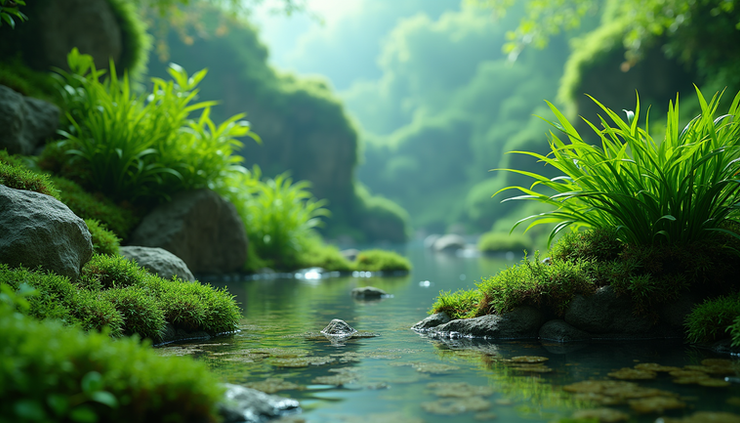
Nature Style Aquascaping
Nature style mimics natural landscapes underwater. It focuses on creating scenes that look like riverbeds, forests, or valleys. This style uses a mix of rocks, driftwood, and a variety of plants to replicate nature’s randomness and balance.
Key features: Asymmetrical layout, natural-looking rock and wood placement, diverse plant species.
Popular plants: Java fern, Anubias, mosses, and carpeting plants like Monte Carlo.
Why beginners like it: It allows flexibility and creativity without strict rules, making it forgiving for new aquascapers.
Nature style encourages observation of real environments, helping beginners learn about plant growth and aquascape balance.
Iwagumi Style Aquascaping
Iwagumi is a minimalist style that originated in Japan. It centers around a simple arrangement of stones, usually three or five, placed in a specific pattern to create harmony and balance.
Key features: Few stones arranged in a triangular layout, minimal plants, open space.
Popular plants: Carpet plants like Hemianthus callitrichoides (dwarf baby tears) or Eleocharis parvula (dwarf hairgrass).
Why beginners like it: The limited elements reduce complexity, making it easier to maintain and design.
Iwagumi emphasizes the beauty of stones and negative space, teaching beginners about composition and proportion.
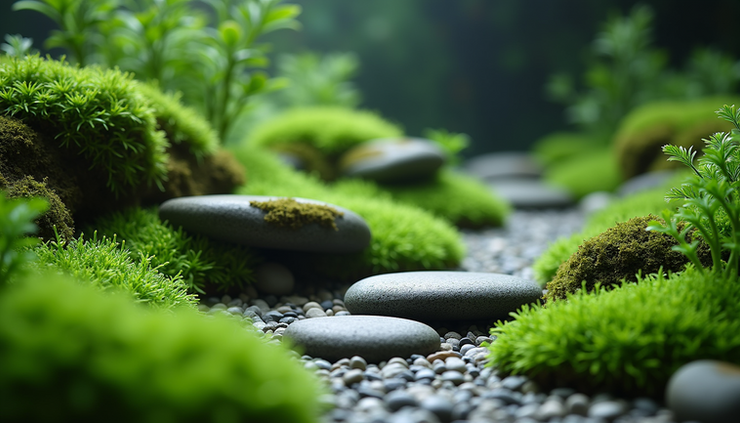
Dutch Style Aquascaping
Dutch style is all about plants. It resembles a garden with rows and groups of colorful aquatic plants arranged in layers and patterns.
Key features: Dense planting, no rocks or wood, strong focus on plant variety and color contrast.
Popular plants: Rotala, Ludwigia, Alternanthera, and various stem plants.
Why beginners like it: It’s visually striking and focuses on plant care, which helps beginners improve their horticulture skills.
This style requires good lighting and CO2 supplementation, so beginners should be ready to invest in equipment.
Jungle Style Aquascaping
Jungle style mimics a wild, untamed underwater forest. It uses dense planting with a mix of tall and short plants, driftwood, and rocks to create a natural, overgrown look.
Key features: Dense, layered planting, natural wood and rock placement, less emphasis on symmetry.
Popular plants: Amazon sword, Vallisneria, Cryptocoryne, and various mosses.
Why beginners like it: It’s forgiving because it doesn’t require precise trimming or layout, allowing plants to grow freely.
Jungle style is great for beginners who want a lush, natural aquarium without strict design rules.

Biotope Style Aquascaping
Biotope style recreates a specific natural habitat, such as a river or lake from a particular region. It uses plants, rocks, and fish native to that environment.
Key features: Authentic materials and species, focus on ecological accuracy.
Popular biotopes: Amazon River, African Rift Lake, Southeast Asian streams.
Why beginners like it: It teaches about natural ecosystems and encourages research, which deepens understanding of aquatic life.
Biotope aquascaping requires attention to detail but offers a rewarding experience by connecting aquascaping with real-world habitats.


Comments